Best Flooring for Kitchens: What Holds Up to Spills, Heat and Traffic
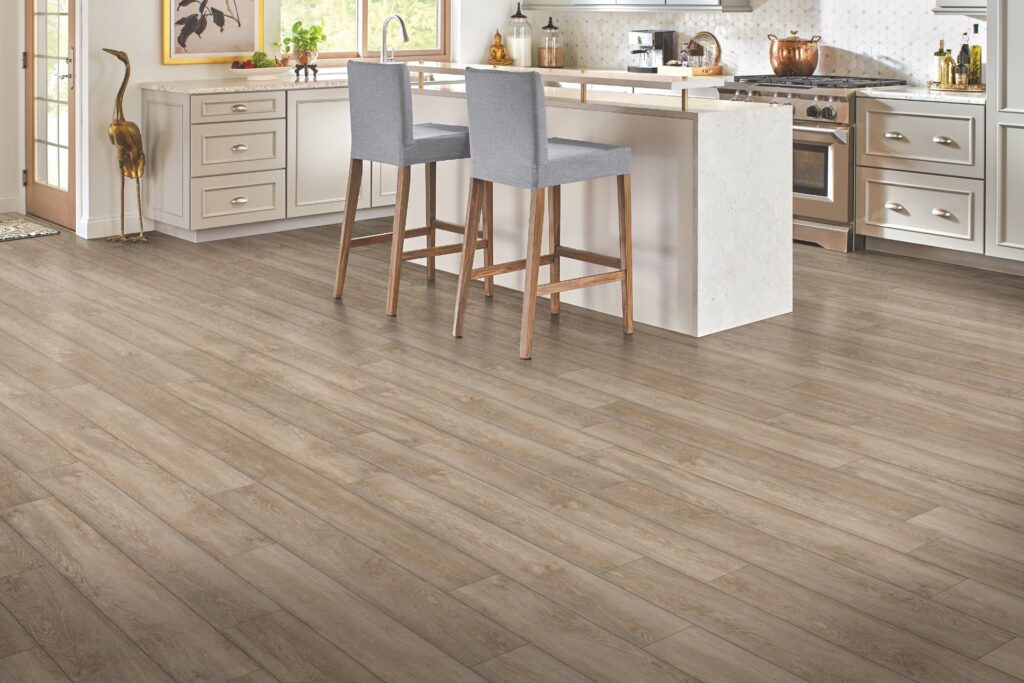 Most flooring guides will rank kitchen floors by how they look, but we think that’s a backwards way to do it. The right material is the most important choice when it comes to choosing new flooring, and a kitchen floor fails in three specific, predictable ways. So what actually destroys floors and which materials hold up? In this guide, we’ll go through the best flooring for kitchens and make sure it looks and performs up to your standard.
Three Ways a Kitchen Floor Fails
Water that sits
Not just a small splash that you wipe up, but a slow leak behind the dishwasher, or a drip at the base of a cabinet sink. Any type of flooring that can stay wet for days is what separates it from water-resistant and waterproof. This is the distinction that most kitchen floors differ.
Heat
The same can be said for heat: two versions are radiant heat under the floor and sunlight coming from above. Both of these things can cause material to contract and expand, and these factors are often ignored in the choosing process.
How It Wears
Kitchens don’t wear as easily as your other rooms. Everything in a kitchen happens within the 3-foot path from a sink, a stove, and a fridge. It is also a common room for grit being tracked in from outside: things getting dirty, spills, and kitchen disasters. Where ratings assume that things get used evenly, but in a kitchen, that’s not the truth.
Flooring Options, Ranked by Survival
Porcelain tile
The genuine hard-to-beat top performer. Porcelain tile is the best when it comes to wear. The Tile Council of North America defines it as “an impervious tile with a water absorption of 0.5% or less, as measured by the ASTM C373 test method” — meaning it doesn’t just resist water; it barely absorbs any. Consumer Reports found ceramic and porcelain “resist wear, moisture, scratches, dents, and stains.” The only downside is if you’re sensitive to temperatures. This hard, cold porcelain underfoot does not radiate heat, and often a dropped glass will not survive it.
Luxury vinyl plank (LVP/SPC)
Definitely the second choice and best all-around compromise if you don’t want tile. This has taken over kitchen remodels in the last decade, and Consumer Reports is clear about why: “Vinyl flooring is especially good at fending off wear, dents, scratches, discoloration from sunlight, and stains,” and it’s “waterproof, so it’s a great alternative to tile in rooms such as baths and kitchens.” Vinyl is quieter and warmer than tile and is definitely more forgiving of dropped dishes and accidents. But not all vinyl is the same. Make sure you pick a high-quality one that will wear evenly over time.
Laminate
Better than its reputation suggests, laminate is a cheap option when redoing your kitchen. Consumer Reports notes “the best laminates resist scratching and discoloration from sunlight better than most wood products.” The only issue with laminate is that the core is fiberboard, meaning that water-resistant laminate spills you wipe up, but standing water still seeps in. If you’re fearful of water damage from a fridge or a dishwasher at some point in your kitchen, this might not be the best option for you.
Engineered hardwood
The only real workable way to get wood in a kitchen. Engineered hardwood has a plywood core and is very dimensionally stable. This means it tolerates things like water, humidity, and sun better than regular wood. But it still isn’t waterproof, and refinishing it would depend on how thick the veneer is. If it ever gets damaged, this is an expensive replacement and one you couldn’t easily repair and move on from. As the Real American Hardwood Coalition explains it, engineered planks are built in layers, and “because the layers run in different directions, they counteract the natural tendency of wood to expand and contract when the humidity changes.” The result: “Engineered wood provides a higher level of moisture protection than traditional wood,” and “because engineered wood is so stable, it is often the preferred partner for radiant heat systems.”
Solid hardwood
Beautiful and incredibly risky, Consumer Reports says plainly that it “isn’t a good choice for basements and other areas that may become damp.” which kitchens certainly qualify as. It can be done, and it looks beautiful, but plenty of people have gorgeous wood in their kitchens that got wrecked by an issue no one could see coming. If choosing solid hardwood, you’re accepting the maintenance and the risk that comes with it.
The Bottom Line: Choosing The Right Flooring
If you want your flooring to outlive your kitchen, then porcelain tile is the best option. But if you want the one most people are happiest with day-to-day, it’s high-grade vinyl with at least 12 layers. Waterproof, warm, and kinder to your feet and dishes. Wood. Remember, wood is just a preference and not a performance choice. As long as you’re fine with the decision you’re making, your kitchen will turn out perfect.